What Ethernet protocols are available?
All Norwegian Subsea Motion Reference Units (MRUs) include Ethernet communication and support the following standard Ethernet protocols:
- UDP
- Modbus TCP
- Ethernet/IP
These protocols ensure seamless integration with a wide range of industrial systems, providing flexibility across diverse applications.
Passive PoE (Power over Ethernet)
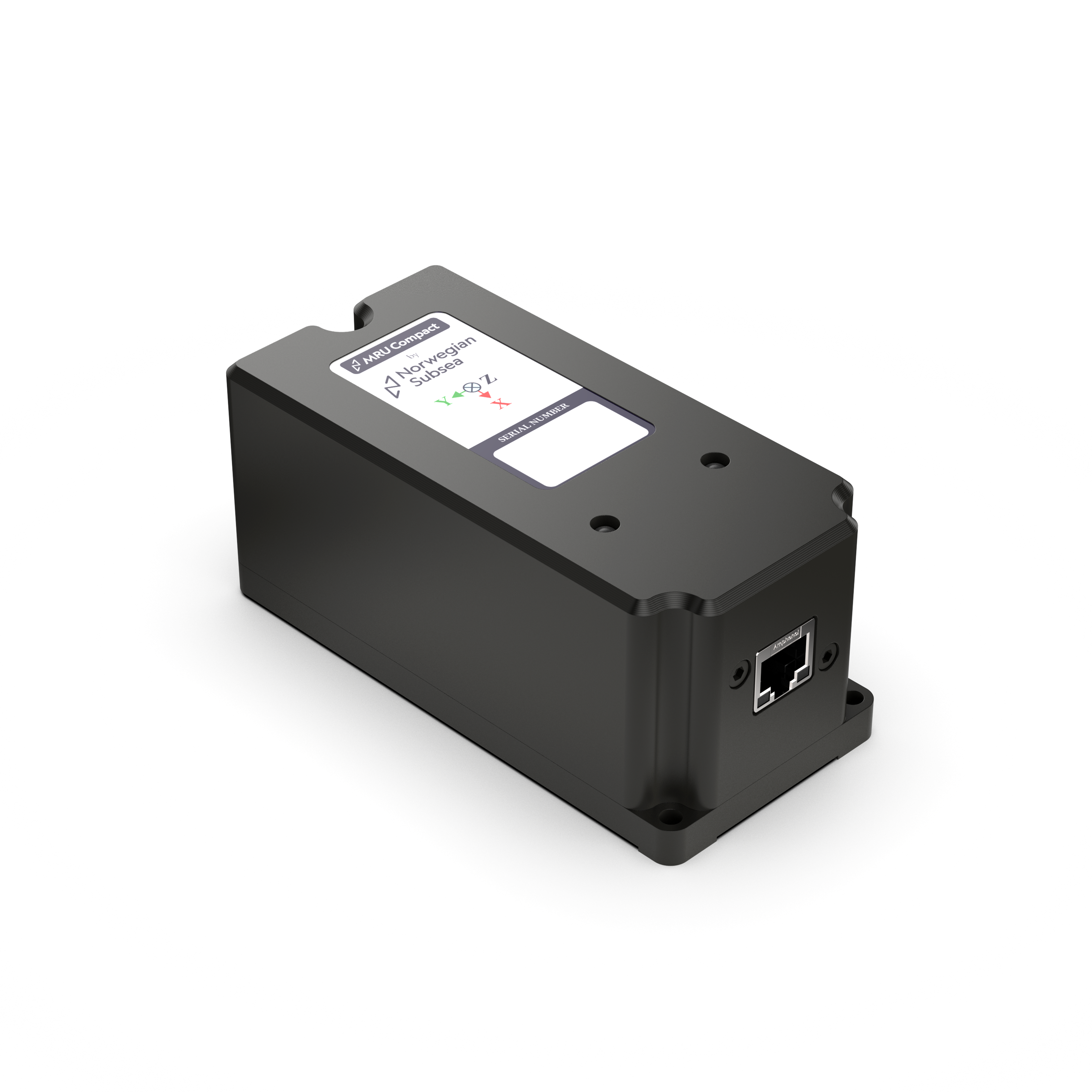
The MRU Compact uses a standard RJ45 Ethernet cable with Passive PoE, supplying power through the same connection. It supports an input voltage range between 9 and 36 V.
Most Ethernet switches use Active PoE, which is incompatible with Passive PoE devices like the MRU Compact. Therefore, the MRU Compact should not be connected directly to an Active PoE switch unless a converter is used.
To facilitate setup, we typically supply the first MRU Compact with a start kit that includes a Passive PoE RJ45 splitter socket. This allows you to connect the MRU Compact using standard Cat5 RJ45 Ethernet cables between your MRU, the splitter, and your PC or Ethernet switch.
For industrial installations, we recommend terminating the Ethernet cable to a terminal block or using an interface module such as this from Wago.
If connecting to an Active PoE switch is necessary, a PoE converter (e.g., from Ubiquity) can be used to convert the Active PoE output to a constant 24 V Passive PoE input.
For more technical guidance, please refer to the MRU Compact user manual.
RJ50 (10-wire Ethernet) Connector
The MRU Compact is also available with an RJ50 connector (also known as 10P10C), instead of the standard RJ45 Ethernet connector. While the RJ50 looks similar to the RJ45, it includes 10 wires instead of 8. The outer two pins, unused in RJ45, are active in the RJ50 connector.
This 10-wire configuration allows for an additional interface alongside Ethernet and power:
- Ethernet & RS-232
- Ethernet & 4-wire RS-485
- Ethernet & PPS time sync
Important: Never insert a standard RJ45 plug into an RJ50 socket. While it may appear to fit, it can damage the connector due to the unused outer pins on the RJ45 interfering with the active pins on the RJ50.
For more detailed specifications or connection guidance, visit our support site or contact us directly.