How do inertial measurement units work in underwater robotics?
Inertial Measurement Units (IMUs) are fundamental components within Motion Reference Units (MRUs) used in underwater robotics like Remotely Operated Vehicles (ROVs) and Autonomous Underwater Vehicles (AUVs). At their core, IMUs utilize MEMS-based accelerometers and gyroscopes to measure linear acceleration (Surge, Sway, Heave) and angular velocity (Roll, Pitch, Yaw) respectively. This provides the essential raw data describing the robot's motion in all six degrees of freedom (6DoF).
However, raw IMU data alone can be susceptible to noise and drift over time. Norwegian Subsea MRUs employ advanced sensor fusion algorithms that intelligently combine data from the IMU with other sensors, such as magnetometers for heading (optional), to produce highly accurate, stable, and reliable real-time motion and orientation measurements. This processed data is crucial for effective underwater operations where external references like GPS are unavailable.
For underwater robotics, this precise motion data is vital for several functions: accurate navigation and positioning, closed-loop control for vehicle stability and maneuvering, and the precise orientation of onboard tools and sensors such as cameras, sonars, and manipulator arms used during subsea surveys, inspections, or intervention tasks.
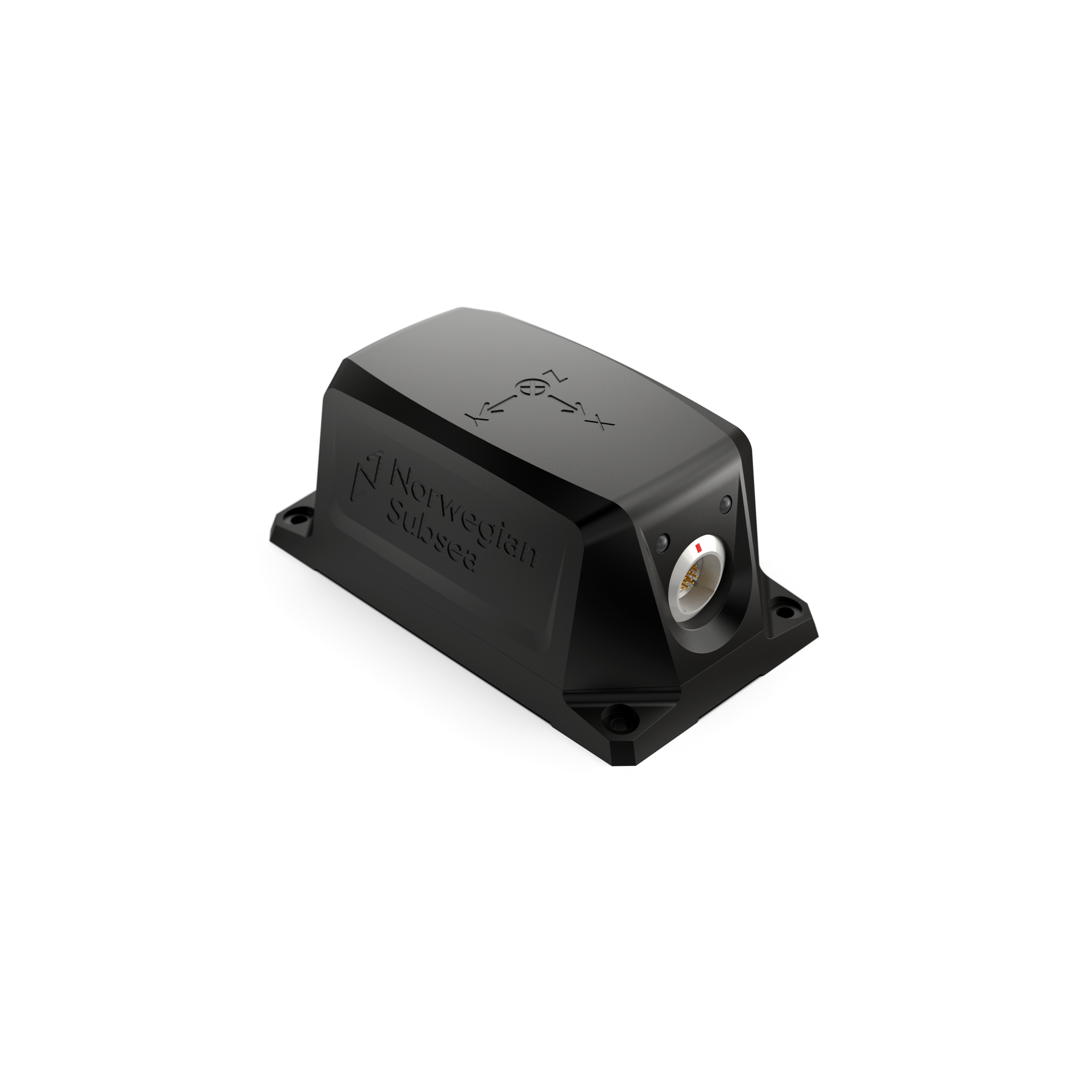
Norwegian Subsea offers the MRU Subsea, specifically designed for these demanding applications. Housed in a compact, robust titanium casing rated for 6000m water depth, it provides high-accuracy motion data (available in ±0.05°, ±0.02°, or ±0.01° Roll/Pitch accuracy variants) essential for ROV/AUV navigation and control. It features easy integration via Ethernet or serial communication (RS-232/RS-485) with standard protocols like UDP and Modbus TCP, and utilizes reliable Subconn connectors. An Inclinometer/VRU version is also available for applications requiring only high-accuracy attitude data.