Does the MRU measure surge and sway?
Yes, our MRUs measure surge and sway.
Note, that as for heave, the measurements are around a zero-mean position. This means that for a ship that moved forward, it’s only the high frequency part of the surge motion that is measured by the MRU.
Accurate surge and sway measurements are dependant on accurate roll and pitch measurements, since small changes in roll and pitch influence the surge and sway measurements. That is why we recommend the 9000 series when surge and sway measurements are important. This can be for applications like 3D motion compensation.
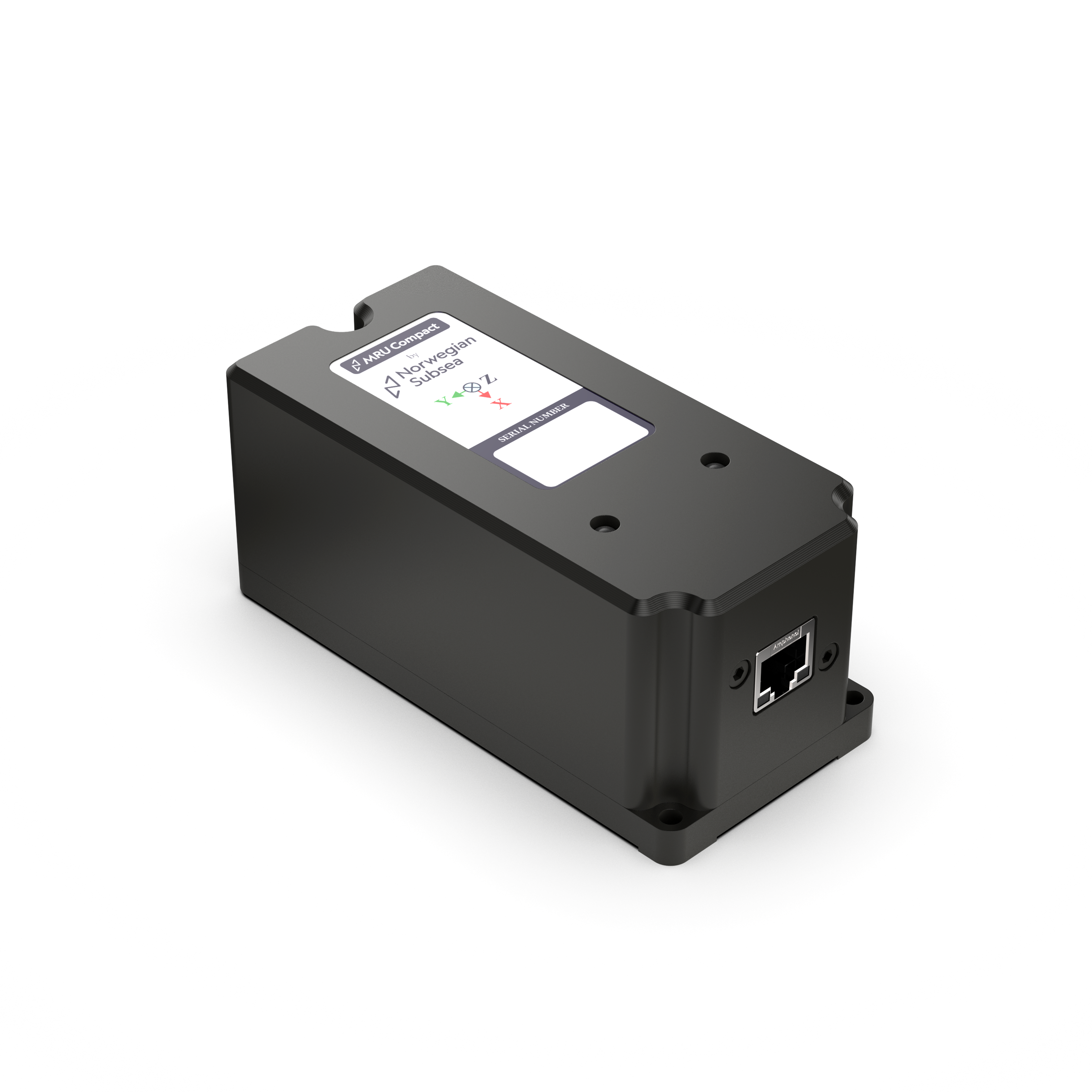
Related products

Usage area
50 m depth, IP 68
Connectors
Lemo or SubConn 8 or SubConn 16
Roll & Pitch accuracy
- 3000±0.05°
- 6000±0.02°
- 9000±0.01°
Heave accuracy
5 cm or 5.0%

Usage area
IP 65
Connectors
RJ45 or RJ50
Roll & Pitch accuracy
- 3000±0.05°
- 6000±0.02°
- 9000±0.01°
Heave accuracy
5 cm or 5.0%
Further reading

MRUs for vessel performance optimisation in focus at Europort 2025

Research Project to Test Value of MRU Data for Vessel Performance and Carbon Reduction

Advanced motion compensation for sonars introduced at Ocean Business 2025
Related questions
- Read the full answer
Although an Inclinometer, Roll & Pitch Sensor, and VRU all measure attitude (roll and pitch), they vary significantly in accuracy, capabilities, and ideal applications:
- Inclinometer: Best suited for basic static tilt measurements. It is ideal for stationary or slow-moving applications where simplicity and low cost are primary concerns
- Read the full answer
Yes, the MRU can output heave measurements, including position, velocity and acceleration at 2 remote monitoring points.
In addition, you can use the measurment point at the centre of gravity and select the CoG position as the position of your 3rd monitoring point. Note: CoG position is not used as part of the calculations and can be set to any position.
- Read the full answer
Data filtering is a critical process within Motion Reference Units (MRUs) designed to refine raw sensor measurements by removing noise and isolating the true motion components. At Norwegian Subsea, our MRUs utilize advanced sensor fusion algorithms and Kalman Filter algorithm that intelligently process data from state-of-the-art MEMS accelerometers and gyroscopes.
These sophisticated algorithms act as highly optimized filters, effectively distinguishing between vessel motion and unwanted noise or vibrations. This ensures the delivery of exceptionally accurate and stable measurements for Roll, Pitch, Heave, Yaw, Surge, and Sway in real sea conditions with irregular waves and coupled motions.
Related applications

Wind Turbines
Accurate and precise motion monitoring is crucial for wind turbine towers to ensure structural integrity and optimise performance.

Bridges
Accurate and high-resolution motion sensors are crucial for the structural monitoring of bridges.

Buildings
Accurate and high-resolution motion sensors are essential for the structural monitoring of tall buildings.

Motion Compensated Gangways
Accurate measurements of all 6 degrees of freedom are essential for the automatic motion control of gangways.

Riser Monitoring
The NORSUB Subsea MRU is specifically designed to provide highly accurate measurements of roll, pitch (inclination), and lateral motions in risers.
Check out
Pariatur ullamco aute exercitation nostrud ullamco tempor officia pariatur occaecat eu ex pariatur. Adipisicing amet sunt minim do tempor duis ea cillum ea nulla ipsum ex. Nisi tempor nisi cillum ex dolor proident eu. Nisi velit elit eu pariatur magna aliqua Lorem amet duis. Eiusmod pariatur consequat elit aliqua cupidatat deserunt nostrud exercitation ullamco voluptate enim reprehenderit velit exercitation occaecat. Exercitation incididunt ut consectetur nostrud dolor aute. Deserunt amet occaecat enim exercitation ut dolore ad ullamco proident non nulla. Qui aute tempor culpa amet.